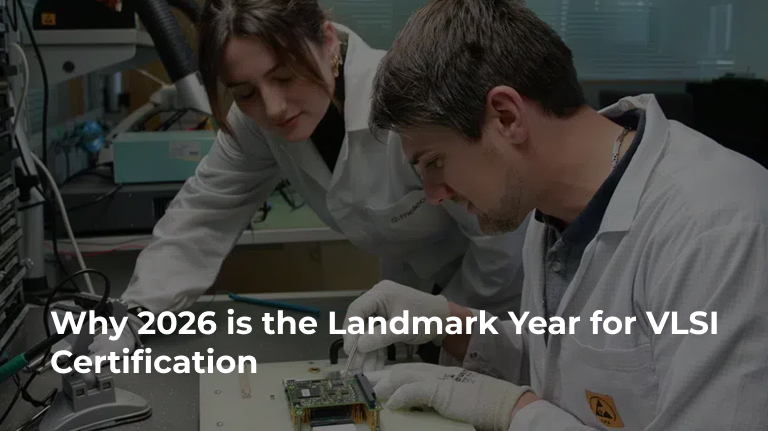
The semiconductor industry is currently entering its most decisive phase. By the end of 2026, India’s semiconductor talent base is expected to reach 220,000 professionals, with a hiring pipeline aiming to add nearly 10 lakh jobs across the ecosystem. However, a significant “job-readiness” gap remains: while India produces over 6 lakh electronics graduates annually, only a small fraction are ready to step into a fabrication or design unit immediately.
A VLSI Online Course with Certificate from Chipedge does more than just fill a resume gap; it provides a stamp of approval from an institute with a long-standing legacy. In 2026, recruiters at MNCs like Intel, NVIDIA, and Qualcomm are no longer looking for generalists; they are looking for specialists who can handle AI-optimized silicon or 3nm/2nm design nodes.
Strategic Domains: Choosing Your Certification Path
The VLSI lifecycle is a complex machine with many moving parts. To “Step Up Your Career,” you must choose a certification that aligns with your specific technical interests and the current market demand.
1. Design Verification (SV & UVM)
Verification remains the highest-volume hiring area in 2026, often consuming 70% of the total design cycle. Certification in this domain proves you can build robust verification environments using SystemVerilog and UVM (Universal Verification Methodology).
- Key Skills: Constrained-random testing, functional coverage, and assertion-based verification.
- Industry Demand: Massive growth in Bengaluru and Hyderabad GCCs (Global Capability Centers).
2. Physical Design (RTL-to-GDSII)
As chips become smaller and faster, the “Back-End” or Physical Design role has become critical. Certification validates your ability to handle the logical-to-physical translation.
- Key Skills: Floorplanning, Clock Tree Synthesis (CTS), Routing, and Static Timing Analysis (STA).
- PPA Focus: Learning to optimize for Power, Performance, and Area at cutting-edge nodes.
3. Design for Testability (DFT)
With the rise of indigenous manufacturing plants (Fabs) and OSAT (Assembly, Testing, and Packaging) units in Gujarat and Tamil Nadu, DFT engineers are more essential than ever.
- Key Skills: Scan insertion, ATPG (Automatic Test Pattern Generation), and BIST (Built-In Self-Test).
- Objective: Ensuring that every chip produced is defect-free before it reaches the consumer.
4. Analog & Mixed-Signal Design
Crucial for the 5G, EV, and IoT sectors, this track focuses on the “real-world” interface of the chip.
- Key Skills: Custom layout, amplifiers, ADCs/DACs, and power management ICs (PMIC).
What Makes an Online VLSI Certification “Effective”?
In 2026, the definition of an online course has evolved. At Chipedge, we focus on three pillars that ensure your certification holds real-world value:
1. 24/7 Remote Lab Access (The Cloud Advantage)
Theory alone is insufficient. Modern online certifications provide VPN access to industry-standard EDA tools (like Synopsys or Cadence toolsets). This allows you to gain “muscle memory” by working on the same software used by senior engineers at top MNCs, all from the comfort of your home.
2. Outcome-Based Curriculum
An effective course doesn’t just list topics; it defines what you can do. By the end of a Chipedge program, you aren’t just a “student”—you are a designer who can:
- Write synthesizable Verilog code.
- Debug complex simulation failures.
- Analyze timing reports to fix setup and hold violations.
3. Industry-Standard Projects
The centerpiece of any quality certification is the Capstone Project. Interviewers in 2026 will ask you to explain your project in detail. Whether it is verifying a RISC-V processor or closing the physical layout of an AI-accelerator block, these projects serve as your technical portfolio.
Salary Trends & Career Growth in 2026
The rewards for specialized VLSI talent in India have never been higher. Semiconductor professionals currently earn 25–35% more than their counterparts in mainstream IT roles.
| Experience Level | Annual Package (LPA) | Top Roles |
| Fresher (0-1 Year) | ₹6 – ₹12 LPA | RTL Trainee, Junior Verification Engineer |
| Mid-Level (3-5 Years) | ₹15 – ₹28 LPA | Senior PD Engineer, DFT Lead |
| Senior (7+ Years) | ₹35 – ₹80+ LPA | Staff Engineer, Architect, Design Manager |
Note: High-end premiums are frequently seen in AI Silicon, Photolithography, and Advanced Packaging roles.
Evaluating Course Quality: The 2026 Checklist
Before you “Explore VLSI Certification,” use this checklist to ensure the program will actually help you secure a job:
- Trainer Experience: Are the mentors industry veterans with 10-15+ years of experience?
- Tool Familiarity: Does the course use licensed software or just open-source alternatives? (MNCs prefer licensed tool experience).
- Placement Ecosystem: Does the institute offer mock interviews, resume-building, and direct connections to hiring partners?
- Alumni Success: Look for a program with a proven track record of placing students in Tier-1 companies.
Frequently Asked Questions (FAQs)
What are VLSI certification courses online?
They are structured, tool-intensive programs that teach specific chip design domains (Design, Verification, PD, DFT) and validate that knowledge through practical assessments.
Why is certification important in the 2026 job market?
With India’s rapid fab expansion, companies need engineers who can contribute on day one. Certification acts as a “Readiness Audit,” proving you have the tools and flow knowledge required for the job.
How are online VLSI certification courses evaluated?
At Chipedge, evaluation is multi-layered, involving periodic quizzes, lab-based assignments, and a final technical assessment to ensure overall readiness.
How should learners choose the best certification program?
Compare curriculum depth (ensure it covers the latest methodologies like UVM or 5nm nodes), tool access quality, and the professional reputation of the trainers.
Can working professionals benefit from VLSI certification?
Yes. Many professionals use these courses to transition from IT or embedded systems into the lucrative silicon sector, leveraging evening or weekend batches to upskill without quitting their jobs.


