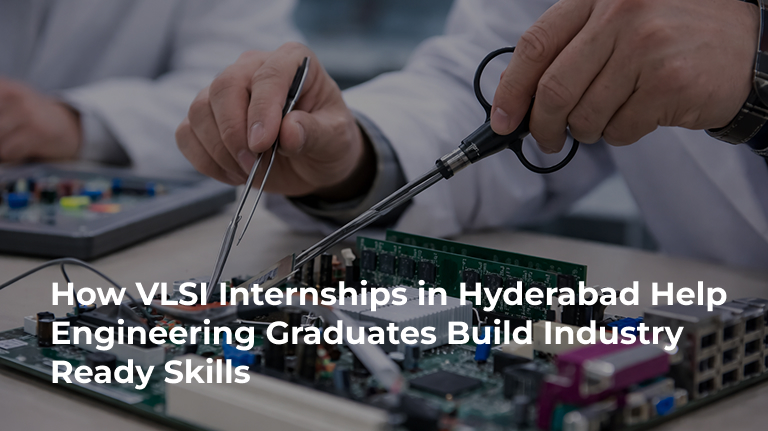
There is a particular kind of confidence that engineering graduates who have completed a serious VLSI internship in hyderabad carry into their first technical interviews — a confidence that comes not from having studied more or memorized more, but from having already done the work in an environment that resembled the one they are being interviewed for. They have seen what a real timing violation looks like in a production design context. They have debugged a simulation failure under the guidance of an engineer who has done it hundreds of times before. They have made a floorplanning decision on a real block and watched how that decision propagated into the placement and routing stages that followed it. That experience, accumulated over the duration of a structured internship, is what separates a graduate who can answer interview questions from a graduate who can answer them convincingly — and in the semiconductor hiring market in Hyderabad in 2026, that difference is the one that determines who gets the offer.
Why Internships Are More Valuable Than Certificates for VLSI Freshers
The certificate that a VLSI training program issues at its conclusion is a signal — it tells a recruiter that the graduate completed a defined curriculum and met whatever assessment standards the institute applied. What it cannot tell the recruiter, on its own, is whether the graduate can actually execute a chip design task on a real project under real constraints with real consequences when something goes wrong. The internship answers that question directly, because it puts the graduate in a professional environment and produces observable, evaluatable outcomes — design blocks that were worked on, bugs that were found and fixed, timing paths that were analysed and closed, testbench environments that were built and exercised. These outcomes are what experienced semiconductor engineers evaluate in technical interviews, and they are qualitatively different from the kind of evidence a certificate alone can provide.
For VLSI freshers in particular, the internship is often the difference between being competitive for a direct hire position and needing to accept a lower-level role that does not reflect the actual level of skill developed during training. Companies hiring in Hyderabad’s semiconductor ecosystem are increasingly distinguishing between candidates who have completed VLSI training and candidates who have completed VLSI training and then applied it in a real professional environment, however briefly — and that distinction shows in both the roles they offer and the packages attached to those roles.
How Hyderabad Has Grown as a VLSI and Semiconductor Industry Hub
Hyderabad’s emergence as a serious destination for VLSI training in hyderabad and semiconductor careers is one of the more significant developments in India’s chip design ecosystem over the past several years, driven by a combination of deliberate government investment, corporate expansion decisions, and the development of a technical talent pool that has made the city increasingly attractive to semiconductor companies looking to grow their India presence beyond Bangalore. Companies including Intel, Qualcomm, Samsung, and a growing number of ASIC design service companies have established or expanded design operations in Hyderabad, creating a hiring market that is deep enough to support multiple placement opportunities for trained VLSI engineers without the geographical concentration challenges that characterise the Bangalore market.
The Telangana government’s active positioning of Hyderabad as a semiconductor and electronics hub — through infrastructure investment, policy support, and engagement with global chip companies — has accelerated this development in ways that are visible both in the number of semiconductor job postings originating from Hyderabad and in the quality of the companies generating those postings. For engineering graduates in Andhra Pradesh and Telangana who are considering a VLSI internship in hyderabad, this growth means that the internship-to-employment pathway in the city is increasingly well-defined, with companies that are actively looking for trained VLSI interns who can convert to full-time roles after demonstrating their capability during the internship period.
What a VLSI Internship in Hyderabad Typically Involves
Frontend Design Tasks
Front end tasks in a VLSI internship typically begin with exposure to the RTL environment — reading and understanding existing RTL code, making modifications to implement specific design changes or fix identified bugs, writing new RTL blocks to specification, and running the simulation flow to verify that the changes behave correctly. Interns working on front end tasks will typically use tools like Synopsys VCS or Cadence Xcelium for simulation, and will work within the existing testbench infrastructure of the project rather than building verification environments from scratch in the early stages of the internship. The value of this front end exposure is that it places the intern inside a real design project where the RTL has a real specification, the simulation results have real meaning, and the bugs found have real consequences — which is categorically different from working on training exercises designed to be solvable within a defined time window.
Backend and Physical Design Exposure
Interns assigned to backend physical design work will typically be involved in specific stages of an ongoing implementation project — running placement experiments on a specific block, analysing timing reports and identifying the sources of specific violations, making routing adjustments to resolve DRC errors, or running parasitic extraction and reviewing the results against timing targets. The physical design flow in VLSI at a professional semiconductor company runs on licensed tools like Synopsys ICC2 or Cadence Innovus, and the experience of operating these tools on a real design block with real timing constraints is the most direct preparation available for the technical questions that physical design interviews focus on. An intern who has actually closed timing on a block in a production environment can describe that experience with a specificity and accuracy that interviewers recognise immediately as genuine, rather than knowledge acquired through training exercises alone.
Verification and Debugging Work
Verification interns in Hyderabad semiconductor companies are typically involved in extending existing testbench environments, writing new directed tests for specific design scenarios, analysing coverage reports and identifying gaps in the existing verification plan, and debugging simulation failures by working through waveforms and identifying the RTL conditions that produced the incorrect behavior. This debugging work is where verification engineers develop the diagnostic intuition that separates effective verification professionals from engineers who can follow a verification plan but struggle when the plan does not account for the specific failure mode that has appeared in simulation — and it is the kind of experience that is almost impossible to simulate in a training environment, because it requires working on a design complex enough that the failure mode is genuinely unexpected.
Skills Engineering Graduates Develop During a VLSI Internship
The skills that engineering graduates develop during a VLSI internship in hyderabad are not simply additions to what was learned during VLSI training — they are qualitative transformations of that knowledge into professional competence. The ability to read someone else’s RTL and understand it quickly enough to modify it correctly is a skill that only comes from doing it on a real codebase with real complexity. The ability to interpret a timing report and identify the most impactful path to work on first is a skill that training exercises approximate but professional experience develops fully. The ability to communicate a technical problem clearly to a senior engineer, to receive feedback that is specific and technical rather than general and pedagogical, and to incorporate that feedback into improved work output — these are professional skills that no certificate program can develop because they require a real professional environment to practice in. Digital VLSI design as practised in production is a collaborative, iterative, feedback-driven process, and the internship is where graduates first experience it as such.
How to Find and Apply for VLSI Internships in Hyderabad
Online Platforms
LinkedIn, Naukri, and Internshala carry a significant volume of VLSI internship in hyderabad postings from semiconductor companies and ASIC design houses operating in the city, and a well-constructed profile on these platforms — one that clearly specifies the VLSI domain, the specific tools and methodologies the candidate has been trained on, and the project work completed during training — substantially increases the visibility of an application to semiconductor recruiters who are filtering for specific technical backgrounds. The profile should be built around the technical specifics of the training — not generic descriptions of “knowledge of VLSI design” but specific statements about the tools used, the design flows executed, and the project outcomes produced, because semiconductor recruiters are engineers themselves and they read profiles with exactly that level of technical specificity in mind.
Institute Connections
The most reliable pathway to a VLSI internship in hyderabad for a fresh graduate is through the placement network of the training institute, because established institutes with active hiring relationships can place interns at companies that are not advertising publicly and can provide context about the candidate’s training that a cold application cannot. ChipEdge’s placement support infrastructure, which includes connections to over two hundred semiconductor hiring companies across India, operates as exactly this kind of active intermediary — matching trained graduates to internship and employment opportunities based on the specific skills and project experience developed during the program, rather than simply circulating resumes through a general job portal.
What Recruiters Look for When Hiring VLSI Interns in Hyderabad
Semiconductor recruiters evaluating candidates for VLSI internship positions in Hyderabad are looking for a combination of technical foundational knowledge and demonstrable tool experience that together indicate the intern will be able to contribute to real project work within a short orientation period rather than requiring extended hand-holding before becoming productive. Specifically, they want to see evidence of having worked on a complete design flow — not just knowledge of individual stages in isolation — because the ability to understand how the design moves through the flow and how decisions at one stage affect subsequent stages is what allows an intern to work effectively within a larger project team. They also look for the kind of communication skills that allow a new engineer to ask useful questions, to understand feedback, and to report on their work status accurately — because intern productivity in a real design team depends as much on effective communication as on technical knowledge.
Common Challenges Interns Face During VLSI Training Programs
The most common challenge that engineering graduates face during their first VLSI internship is the transition from working on self-contained training exercises — where the problem is defined, the tools are configured, and the expected outcome is known — to working on a real design project where the problem is sometimes ambiguous, the tool environment has project-specific configurations that are not self-explanatory, and the expected outcome is defined by a specification document that requires interpretation rather than a training brief that tells the student exactly what to do. This ambiguity is not a problem to be solved before the internship begins — it is the primary learning experience of the internship, and the graduates who navigate it most effectively are the ones who have been trained to ask specific, technical questions rather than general questions, who are comfortable working with incomplete information, and who have enough tool experience that the learning curve on the project-specific environment is manageable rather than overwhelming.
How to Make the Most of a VLSI Internship Opportunity
Making the most of a VLSI internship in hyderabad requires approaching it with the same professional seriousness that a permanent employee brings to their work, rather than with the more tentative engagement that the temporary status of an internship might seem to justify. The interns who convert their internships to full-time offers — and conversion rates at Hyderabad semiconductor companies for well-performing interns are meaningful — are consistently the ones who take ownership of their assigned tasks rather than waiting for direction at every step, who communicate proactively about their progress and the obstacles they are encountering, and who treat every interaction with a senior engineer as an opportunity to learn something that was not covered in their training program. Asking a senior engineer to explain the reasoning behind a design decision that is not obvious from the specification, or to walk through a timing closure approach that is different from what was taught during training, is not an imposition — it is exactly the kind of professional engagement that experienced engineers respect and that builds the professional reputation that leads to an offer.
What Comes After Completing a VLSI Internship in Hyderabad
The outcomes after a completed VLSI internship in hyderabad follow a reasonably predictable pattern for graduates who performed well and built visible contribution during the internship period. The most common outcome for strong performers is a direct offer from the internship host company, either as a full-time engineer or as a contract engineer with a defined path to permanent employment. For graduates whose internship company does not have an immediate opening in the specific domain they worked in, the internship experience transforms the job search significantly — a candidate who can describe six months of real design work on a production project at a named semiconductor company in Hyderabad is in a categorically stronger position in the hiring market than a candidate whose profile shows only training program completion, and the conversion from interview to offer reflects that difference clearly.
How a VLSI Internship Compares to Online Only Training for Career Readiness
A VLSI online course with certificate and a VLSI internship in hyderabad are not alternatives to each other — they are sequential stages of career preparation that work most effectively when combined, with structured online training providing the foundational knowledge and tool proficiency that makes an internship productive, and the internship providing the professional experience that makes the training credential meaningful in the hiring market. Engineers who attempt internships without sufficient prior training find themselves unable to contribute meaningfully because they lack the basic tool proficiency and design flow understanding that real project work requires from the first week. Engineers who complete strong training programs without any subsequent professional experience find that their credentials are competitive but their interview performance lacks the depth that comes from having actually worked on real designs. The combination of rigorous VLSI training — through a program like ChipEdge that provides genuine tool access, experienced faculty, and structured project work — followed by a serious internship is the most reliable pathway to the kind of career readiness that results in offers from semiconductor companies rather than rejections at the technical interview stage.


