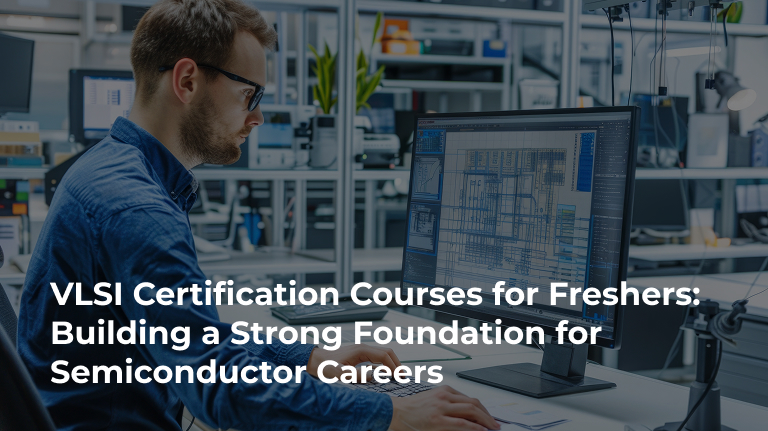
Freshers entering the semiconductor industry often realise that academic learning alone may not fully prepare them for real chip design workflows. Concepts like RTL coding, verification, timing analysis, and physical design are usually introduced at a basic level in college, while the industry expects a stronger practical understanding.
Structured semiconductor training programs help bridge this gap by combining theoretical learning with practical exposure to chip design workflows.
With the rapid growth of semiconductor manufacturing, AI hardware, automotive electronics, and SoC development, demand for skilled VLSI professionals continues to rise across India and global markets. Semiconductor hubs such as Bangalore and Hyderabad are seeing increasing hiring demand for engineers trained in design, verification, FPGA, and backend implementation.
Many learners now prefer flexible online and classroom-based programs that include labs, guided exercises, and project-oriented learning.
Why Certification Matters for Freshers
A certification represents more than course completion. It reflects structured learning, practical exposure, and familiarity with semiconductor workflows.
Recruiters increasingly value candidates who can demonstrate hands-on understanding alongside theoretical knowledge. Freshers who gain exposure to simulations, debugging exercises, and implementation tasks often feel more confident during interviews and technical discussions.
These programs help students:
- Understand RTL design and verification flow
- Gain exposure to ASIC and FPGA implementation
- Build familiarity with simulation and synthesis tools
- Improve debugging and problem-solving skills
- Learn industry-oriented design methodologies
Together, these skills support readiness for entry-level semiconductor roles.
What Students Learn
A well-rounded training program typically covers multiple VLSI domains, including:
- Digital VLSI design fundamentals
- Verilog and RTL coding practices
- Functional verification using SystemVerilog
- FPGA design and implementation
- Physical design basics
- Static Timing Analysis (STA)
- Design-for-Testability (DFT) concepts
Most programs also include practical assignments and mini-projects that help learners understand real semiconductor workflows.
For example, students may work on RTL-to-GDSII mini projects, simulation-based debugging tasks, or hands-on ASIC implementation exercises to better understand chip design and verification processes.
Tool Exposure and Practical Learning
VLSI is a highly tool-driven field. Along with conceptual understanding, practical exposure to design and verification environments plays an important role in industry readiness.
Many semiconductor training programs introduce learners to industry-standard tools used for synthesis, timing analysis, simulation, and physical design workflows.
Learners are typically introduced to:
- RTL coding and simulation
- Testbench development
- Timing analysis exercises
- Debugging waveform behaviour
- Understanding synthesis and implementation reports
This practical approach helps students connect theoretical concepts with real-world semiconductor design challenges.
Common Challenges Freshers Face
Many beginners initially assume VLSI mainly focuses on RTL coding. However, semiconductor workflows also involve verification, timing closure, debugging, and implementation constraints.
Freshers often face challenges in:
- Understanding verification methodologies
- Debugging simulation mismatches
- Interpreting timing analysis reports
- Connecting design behaviour with verification outcomes
Structured learning with guided mentorship, repeated lab exercises, and project reviews helps learners gradually build confidence in these areas.
How to Choose the Right Course
Before enrolling in a semiconductor training program, students should evaluate whether the course includes:
- Coverage of RTL, verification, and backend basics
- Practical assignments and project-based learning
- Mentor guidance and doubt-clearing support
- Exposure to industry workflows and tools
- Interview preparation and placement assistance
Programs that combine theoretical concepts with implementation-focused learning often provide stronger preparation for semiconductor careers.
Career Opportunities After Certification
After completing structured training, freshers can prepare for roles such as:
- RTL Design Engineer
- ASIC Verification Engineer
- FPGA Engineer
- Physical Design Engineer
- DFT Engineer
Entry-level engineers often begin with block-level development, simulation support, verification tasks, or implementation exercises before progressing to larger semiconductor projects.
Practical exposure during training helps learners adapt more confidently to professional chip design environments.
Why ChipEdge Stands Out
ChipEdge offers semiconductor training programs designed to help learners strengthen both conceptual understanding and practical skills.
The programs combine digital design fundamentals with guided exposure to RTL coding, verification, FPGA implementation, and physical design workflows.
Learners are introduced to simulation exercises, debugging activities, and implementation-oriented tasks that support stronger industry readiness for semiconductor careers.
FAQ
What topics are usually covered in semiconductor training programs for freshers?
Programs generally include digital design fundamentals, RTL coding, verification concepts, FPGA basics, timing analysis, physical design introduction, and debugging exercises.
Are these programs suitable for students with no prior industry experience?
Yes. Most courses begin with foundational concepts before gradually introducing advanced semiconductor workflows and practical implementation.
Do online programs include practical exposure?
Many online programs provide lab exercises, simulations, project work, and guided tool-based learning to support practical understanding.
Can certification improve job readiness?
Yes. Practical assignments, project exposure, and workflow familiarity help students strengthen technical confidence for entry-level semiconductor roles.
What roles can students pursue after completing training?
Freshers may explore opportunities in RTL design, ASIC verification, FPGA development, physical design, and DFT engineering.
CTA
Build stronger semiconductor career readiness through practical RTL, verification, FPGA, and ASIC workflow training designed for aspiring VLSI engineers at ChipEdge.


