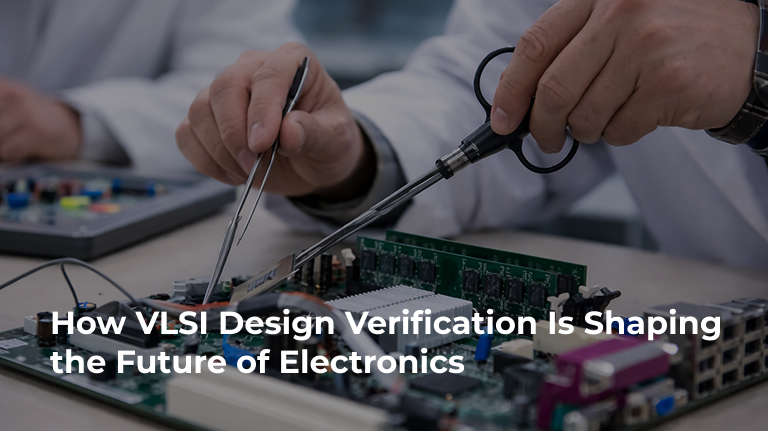
The devices we use every day which include smartphones and smartwatches and electric vehicles and cloud servers depend on chips which need to operate without any errors. Design Verification stands as the unseen protector which safeguards every dependable semiconductor product. Modern electronics require more than chip design because designers must prove their designs as correct and efficient and robust before actual silicon production begins. VLSI Design Verification establishes its vital function through its ability to transform chip design processes.
As chip complexity increases, so does the importance of professionals trained through a structured VLSI Design Verification Course.
The Hidden Engine Behind Reliable Chips
When a chip design is created at the RTL level, it represents logic and functionality. But how do companies ensure that the logic behaves exactly as intended?
Design verification answers that question.
It ensures:
- Functional correctness
- Protocol compliance
- Performance validation
- Error detection before fabrication
- Reduced silicon re-spins
A single bug discovered after tape-out can cost millions. Verification prevents that risk.
This is why semiconductor companies often allocate 60–70% of development effort to verification.
Why Verification Matters More Than Ever
The electronics industry is evolving rapidly.
Consider:
- AI accelerators with billions of transistors
- Automotive chips requiring zero-failure tolerance
- 5G communication processors
- IoT devices operating under constrained power
These systems cannot afford errors.
Verification is not optional—it is foundational.
Professionals trained through a structured VLSI Design Verification Course learn how to validate complex digital systems using systematic methodologies and industry tools.
What Makes Design Verification Powerful?
Modern verification relies on:
- SystemVerilog
- Universal Verification Methodology (UVM)
- Assertions (SVA)
- Formal verification techniques
- Coverage-driven verification
These techniques create an intelligent test environment that simulates real-world operating conditions long before manufacturing begins.
Instead of manual testing, verification engineers build reusable test benches that stress-test designs automatically.
This structured approach ensures predictability and reliability in modern electronics.
The Rise of Verification Careers
As chip architectures grow more complex, verification engineers are in high demand.
Why?
Because:
- Verification teams are larger than design teams in many companies
- Every semiconductor company needs skilled verification professionals
- Functional validation is critical across domains—AI, automotive, mobile, networking
A well-designed VLSI Design Verification Course equips graduates with:
- Strong RTL understanding
- Testbench development skills
- UVM architecture knowledge
- Debugging capabilities
- Simulation tool proficiency
These competencies directly align with industry hiring needs.
Verification and the Future of Electronics
Electronics is entering a new era.
1. Artificial Intelligence Hardware
AI chips must process massive parallel workloads accurately. Verification ensures correctness under extreme data loads.
2. Autonomous Vehicles
Safety-critical chips must meet strict compliance standards. Verification validates edge cases that could otherwise cause failures.
3. Cloud Infrastructure
High-performance processors require stress-tested architectures. Verification guarantees performance consistency.
4. Advanced Node Designs
As technology nodes shrink (7nm, 5nm, and beyond), error tolerance margins reduce. Verification becomes even more critical.
Without verification, innovation slows down. With it, electronics advances confidently.
Skills That Define a Modern Verification Engineer
A structured VLSI Design Verification Course builds a combination of technical and analytical skills:
- Understanding digital design fundamentals
- Writing verification environments using UVM
- Implementing assertions for bug detection
- Debugging waveform simulations
- Analyzing coverage metrics
Beyond coding, verification engineers develop strong logical thinking and systematic debugging abilities—traits highly valued in semiconductor teams.
Industry Tools That Shape Learning
Professional verification training includes exposure to:
- Synopsys VCS
- Simulation and waveform analysis tools
- Formal verification frameworks
Hands-on practice is critical. Reading about verification is not enough. Engineers must interact with real toolchains to build confidence.
At ChipEdge, verification programs emphasize lab-driven learning environments that mirror actual semiconductor workflows.
Why Students Are Choosing Verification
Many engineering graduates now see verification as:
- A stable long-term semiconductor career
- A domain with consistent hiring demand
- A role that combines coding and hardware understanding
- A pathway to global semiconductor companies
Unlike generic software roles, verification offers domain specialization in core electronics.
A structured VLSI Design Verification Course becomes the bridge between academic knowledge and semiconductor industry execution.
Beyond Debugging—Driving Innovation
There is a misconception that verification is only about finding bugs.
In reality, verification:
- Improves design architecture
- Enhances product reliability
- Reduces time-to-market
- Optimizes chip performance
It shapes innovation by ensuring ideas become dependable products.
Without verification engineers, modern electronics would simply not scale.
The Road Ahead for Verification
The future holds:
- ML-driven verification techniques
- Automated coverage analysis
- Advanced formal verification adoption
- Increased system-level validation
As chips become smarter, verification methodologies will become even more sophisticated.
The need for trained professionals will only grow.
Conclusion
The VLSI Design Verification process functions as the core element which maintains electronic device reliability throughout semiconductor manufacturing processes. Verification processes confirm that new developments achieve perfect operational performance for all products ranging from artificial intelligence processors to self-driving automobiles. Verification skills create career opportunities for future engineers because this field stands as a vital and enduring area of semiconductor engineering.
The validation process together with precise measurement and accurate results constitutes the essential foundation which verification engineers use to establish the future of electronic devices.
Contact us today and take the first step toward becoming a skilled verification engineer.


